
Jack London
Naturalism and Lack of Imagination of “the Man”
A short analytical essay by Lynne Hathaway
Jack London’s “To Build a Fire” fits into the naturalism literary period because of its narrative detachment, its depiction of the indifference of nature towards man, and its portrayal of man’s lack of control over his own fate despite his perceived superiority. One theme that the story explores that does not quite fit the naturalist narrative might be the man’s lack of imagination.
The tone of the tale is definitely aloof and matter-of-fact because the narrator is clearly detached from the story, focusing on the series of events with a distant point-of-view narrative. Additionally, the reader only knows the main character as “the man” throughout the tale. What little details about “the man” that are provided are given sparingly as if they are only specified because it helps tell the story. According to the Encyclopedia of Adventure Fiction, the man had a name in an earlier version of the story, but in the later, revised version, the protagonist is merely referred to as “the man.” The same source suggests that, “London dropped the character’s name for the 1908 revision, possibly to underscore his universality. He is representative of all humankind, convinced of superiority but deluded by believe in the conquest of the natural world” (D’Ammassa).
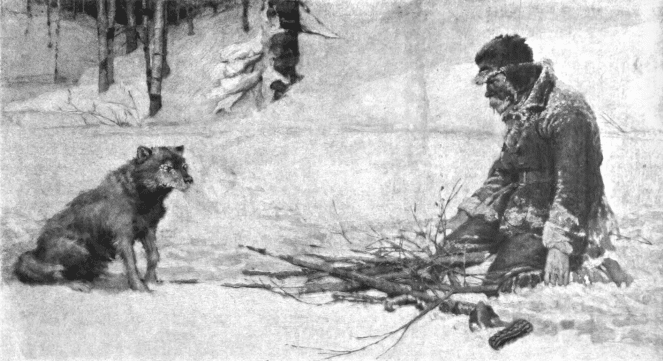
Characteristically, the natural world is unemotional and unaware of the fate of the man. Like nature, the dog is also indifferent to the man and his fate. To the dog, the man is inconsequential except for his ability to provide food and protection, “…all the while the dog sat and watched [the man], a certain yearning wistfulness in its eyes, for it looked upon him as the fire-provide, and the fire was slow in coming” (London, 282).

One example of nature’s indifference to man begins when the man falls into an unseen fissure in the ice while traversing the frozen tundra of Alaska. He successfully builds a fire and commends himself on his survival skills, “He remembered the advice of the old-timer on Sulphur Creek, and smiled. The old-timer had been very serious in laying down the law that no man must travel alone in the Klondike after fifty below. Well, here he was; he had had the accident; he was alone; and he had saved himself. Those old-timers were rather womanish, some of them, he thought. All a man had to do was to keep his head, and he was all right. Any man who was a man could travel alone” (257). Right on cue, nature jumps on the chance to teach the man a lesson, because everyone knows that “pride goeth before the fall,” and since nature is not known to miss such a fortuitous opportunity, she takes full advantage of it: “High up in the tree one bough capsized its load of snow. This fell on the boughs beneath, capsizing them…. It grew like an avalanche, and it descended without warning upon the man and the fire, and the fire was blotted out! …The man was shocked. It was as though he had just heard his own sentence of death” (288). Nature wins this round, and the man knows it, for he cannot survive without fire. It’s as if he is recognizing nature’s strength for the first time, and his own nothingness in comparison. He desperately tries to restart the fire, but fire, a natural element, obeys its own rules, not the man’s, and the man is unsuccessful.

Right on cue, nature jumps on the chance to teach the man a lesson, …and since nature is not known to miss such a fortuitous opportunity, she takes full advantage of it…
It finally begins to dawn on the man that he is in a dire situation. Even though the dog and the old man from Sulphur Creek were aware of the risks of severe cold from the start, only at this point does the man accept that he is likely to die, “A certain fear of death, dull and oppressive, came to him. This fear quickly became poignant… it was a matter of life and death with the chances against him” (292). The quote demonstrates the man’s realization that he is not the superior being that he thought he was and he finally begins to gain respect for nature and its power. Alas, the realization comes too late.
Early in the story, the man’s principal character flaw seems to be that he is without imagination and the narrative confirms it, “The trouble with him was that he was without imagination. He was quick and alert in the things of life, but only in the things, and not in the significances”(281). The man’s over-confidence in himself causes him a distinct lack of vision and he focuses on immediate events rather than envisioning the unforeseen future possibilities. The quote insinuates that the man’s knowledge of the “things of life” isn’t everything there is to know and it’s not enough to guarantee survival, especially in nature’s own backyard. “It was his last panic. When he had recovered his breath and control, he sat up and entertained in his mind the conception of meeting death with dignity” (293). Even with his last breaths, the man still clings to his logicality by endeavoring to die with dignity, yet, this passage also shows the man at his most imaginative state because he is able to consider a possible future if he were to somehow survive.
Characteristics of the naturalism literary movement permeate the tale and is especially evident in the detached tone of the story from beginning to end. Nature’s indifference to man is plainly evident and, sadly, man’s lack of control over his own fate is profoundly demonstrated. The man’s utter lack of imagination kept him from predicting and preparing for unforeseen circumstances and caused him to ignore the warning by the old man at Sulphur Creek. Skillfully woven together by the author into an impressive tale, Naturalism paired with the study of the consequences of lack of imagination, present a complete study of man’s desperate and naïve struggle against nature. In the end, the man is conspicuously absent, having fallen into a peaceful (and permanent) sleep, but the dog, and nature, continue on without even a second thought for the man: “A little longer [the dog] delayed, howling under the stars that leaped and danced and shone brightly in the cold sky. Then it turned and trotted up the trail in the direction of the camp where, it knew, there were other food-providers and fire-providers” (294).
The dog…turned and trotted up the trail in the direction of the camp where, it knew, there were other food-providers and fire-providers.”
Jack London, “To Build A Fire.”
Source Citations:
D’Ammassa, Don. “‘To Build a Fire.’”Encyclopedia of Adventure Fiction, Second Edition, Facts On File, 2014. Bloom’s Literature, online.infobase.com/Auth/Index?aid=0&itemid=WE54&articleId=27092. Accessed 8 Oct. 2021.
London, Jack. “To Build A Fire.”American Literature: Volume 2, edited by William Cain, Pearson Longman, 2004, pp. 280-294.
Lynne J Hathaway
Lynne is always available for side collaborations and talks worldwide. If you want to chat about design, books, or anything else, don’t hesitate in reaching out.
Modern_Inklings@icloud.com

 Modern Inklings
Leave a comment